
JTEK ETF Review: JPMorgan’s Active U.S. Tech Leaders ETF Delivers On Its Growth Promise, But Valuation Concerns Are High
In this article, I would like to initiate coverage on the JPMorgan U.S. Tech Leaders ETF (JTEK). At first glance, it sounds like a safe play - tech stocks are typically very profitable and high-quality, and my analysis confirms JTEK is no exception. However, my analysis also revealed that it's a relatively high-risk play that's more likely than its peers to realize a substantial value re-rating if earnings growth softens. As a result, and despite my belief that tech should form a key part of most investors' portfolios, I've assigned JTEK a "sell" rating, and I look forward to explaining why in further detail below.
JTEK ETF Overview
According to its website, JTEK "actively invests in innovative technology companies across market capitalizations with underappreciated growth opportunities." As a tech fund, it's no surprise that capital appreciation is the primary objective, but unique to JTEK is its reliance on two portfolio managers with extensive experiences who actively make trades on behalf of the fund's shareholders. Ultimately, the goal is to be more nimble than rules-based passive funds and respond well when market conditions warrant, but this expertise certainly doesn't come free. JTEK's expense ratio is quite high at 0.65%, but it's still managed to amass roughly $3.3B in assets since its launch over two years ago on October 4, 2023.
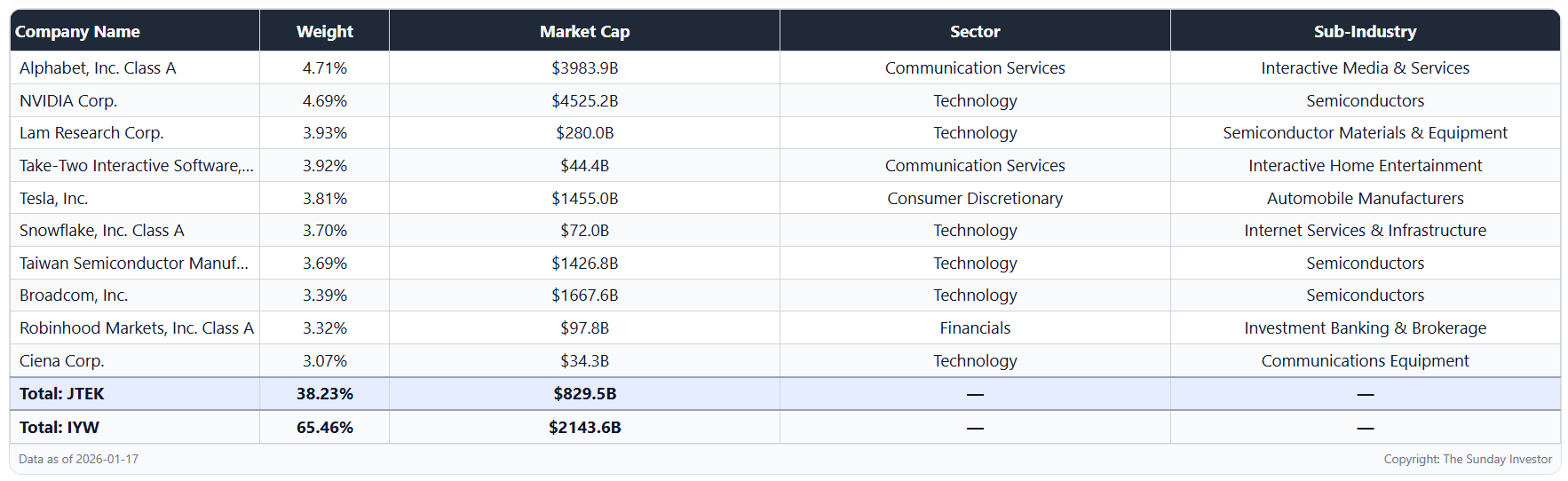
JTEK is currently less reliant on mega-cap growth stocks. As shown below, its top ten holdings comprise only 38% of the fund, and the ETF also includes stocks in other sectors under the GICS system. These include Alphabet (GOOGL), which is categorized as a Communication Services stock, as well as Take-Two Interactive Software (TTWO) and Tesla (TSLA). Others, like Nvidia (NVDA), are included in the fund but often have smaller weightings, which makes room for smaller companies like Robinhood Markets (HOOD) and Ciena (CIEN) into the top ten.
JTEK Performance Summary
Unfortunately, it's hard to draw conclusions about JTEK based on its performance-to-date, as its track record is just too short. However, for what it's worth, it's not too encouraging yet. Based on the performance statistics below, the iShares U.S. Technology ETF (IYW) outperformed JTEK by an annualized 1.77% (35.66% vs. 33.89%) from November 2023 to December 2025). JTEK also had a higher drawdown in Q1 2025 and inferior risk-adjusted returns, as measured by the Sharpe and Sortino ratios. It's my first clue that risk is potentially a problem with this strategy.

JTEK Fundamental Analysis
When digging deeper into JTEK's underlying portfolio, it appears as though its managers seek to hold the highest-growth stocks and mostly ignore risk or valuation. For example, JTEK's components have increased sales and earnings per share by an annualized 21-22% over the last three years. Directionally, I see improvements as well, given how its 29.41% one-year estimated earnings growth rate is about 8% better than its 3Y CAGR and about 4% better than IYW's. Therefore, if high growth is your only focus, it's very difficult to argue that JTEK doesn't meet expectations.
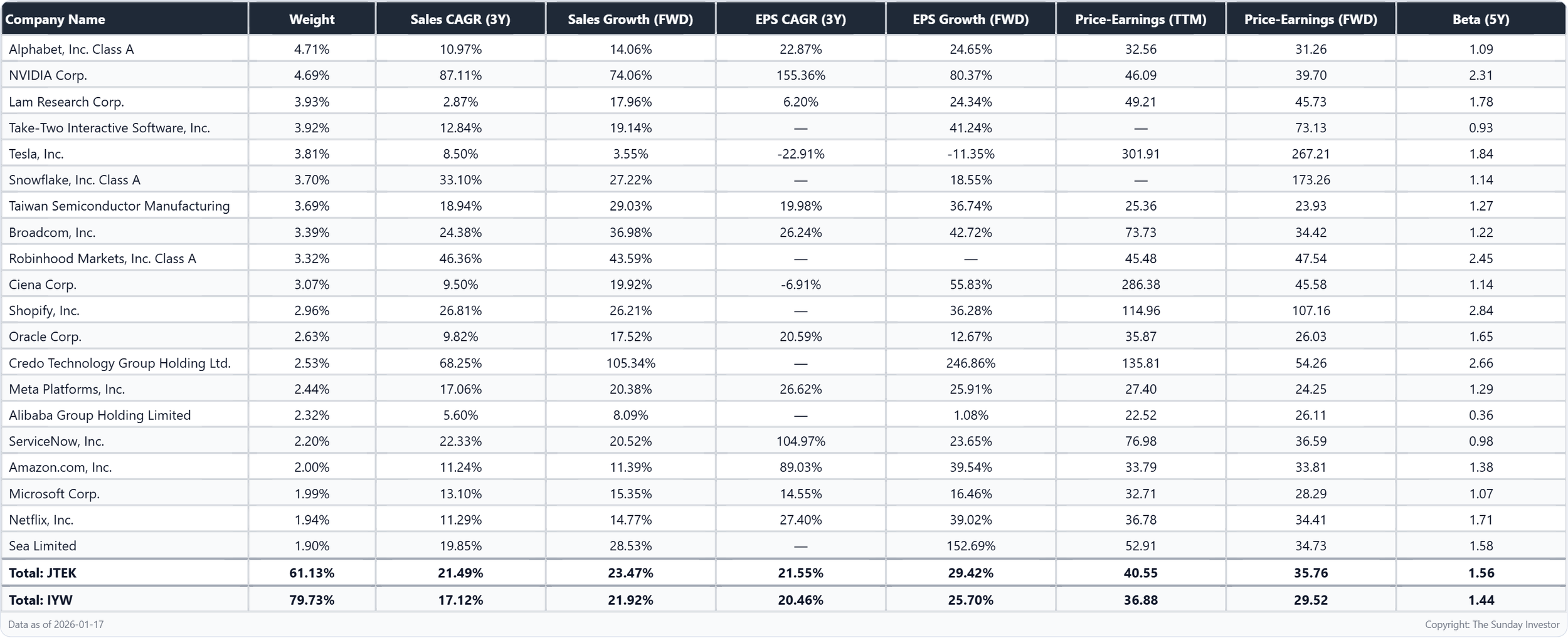
However, I don't recommend buying any stock without regard for other factors like risk and value. For example, S&P Dow Jones reports that large-cap tech stock P/E ratios compressed by 26% in aggregate in 2022, and based on JTEK's 40.74x P/E ratio, it's reasonable to assume that it would have suffered a significant drawdown had it been operating that year. Similarly, its 1.56 five-year portfolio beta indicates a high degree of market risk even compared to other tech funds like VGT (1.45) and XLK (1.43).
After comparing the two ETFs in further detail, I found that the source of excess valuation is primarily due to JTEK overweighting ten stocks, which I've listed below. These stocks collectively trade at 42.60x trailing earnings and 44.06x forward earnings, both of which are higher than the portfolio average, and confirming that they contribute negatively to the fund's valuation.
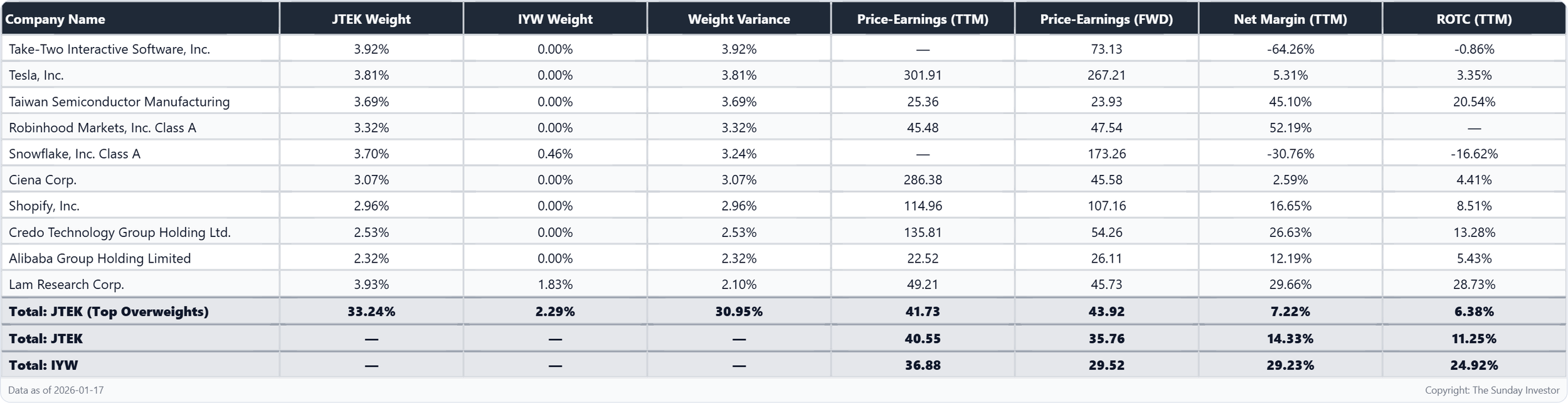
These stocks also reduce quality. For example, Take-Two Interactive Software (TTWO) and Snowflake (SNOW) reported negative earnings over the last year, and in total, the above top ten overweighted stocks have just 7.00% net margins and a 6.34% ROTC on average. For me, it's further evidence that JTEK holds more speculative positions than broad-based tech funds like IYW.
Investment Recommendation
While I'm leaving open that possibility and committing to regular updates throughout the year, JTEK simply has not yet demonstrated an ability to outperform a passive benchmark, represented by IYW. JTEK undoubtedly has an excellent portfolio growth rate, and I reiterate that I believe tech stocks should form a key part of most investors' portfolios. However, its 40.74x TTM P/E ratio is an important headwind, and lower profitability margins and capital efficiency ratios make me concerned that JTEK operates with too much risk in its current form. Therefore, I've decided to assign it a "sell" rating. Thank you for reading.